





If you are sourcing for a music program, stocking your retail store, or just buying your first instrument, the choice between German and Baroque (English) styles isn’t just a matter of preference—it determines whether the instrument is actually usable for your specific needs.
Here is exactly what you need to know before placing an order.
The Real Difference: It’s All About the “F”
The core distinction between the two lies in how you play the note F (or Fa).
German Fingering: This was literally invented to make things easier for absolute beginners. To play an F, you simply lift your fingers in a straight, sequential line. No tricky finger gymnastics. It’s a fast-track for younger kids who just want to play simple folk tunes right away.
Baroque (English) Fingering: This is the traditional, historical standard. Playing an F requires “cross-fingering” (skipping a hole). It takes a bit more muscle memory early on, but in return, the pitch is remarkably accurate, and the instrument easily handles complex chromatic scales.
The Quick Visual Test You don’t need to be a musician to tell them apart. Look closely at the bottom section of the recorder (specifically holes 4 and 5, counting down from the mouthpiece).
German: Hole 4 is visibly smaller than Hole 5.
Baroque: Hole 4 is visibly larger than Hole 5.
Material Choice: Classroom Survival vs. Acoustic Warmth
Once you get the fingering right, the material dictates the lifespan and tone of the instrument.
ABS Resin: If you are supplying a school district or selling heavily on e-commerce, ABS resin is the workhorse you need. It survives being dropped on cafeteria floors, is completely immune to humidity changes during overseas shipping, and can be easily washed in a sink. The tooling on modern ABS recorders is so precise now that they rival basic wooden models in intonation.
Natural Wood (Maple or Pearwood): Wooden recorders deliver that sweet, resonant, traditional tone. However, they are strictly for disciplined students. Wood requires a “break-in” period, regular oiling, and careful swabbing to prevent moisture buildup from cracking the instrument.
What Should Be in the Box? (Accessories Matter)
If you are sourcing these for retail, never just sell the bare instrument. A proper recorder set must include a fitted carrying bag (canvas or heavy-duty vinyl—hard plastic cases tend to crack during bulk transit), a cleaning rod, and a fingering chart. For wooden models, cork grease for the joints is non-negotiable to maintain an airtight seal.
The Bottom Line for Buyers
Stock German if: You cater to casual hobbyists, toy stores, or early childhood programs where the goal is simply to get kids making music within the first five minutes.
Stock Baroque if: You are selling to formal school music programs, private tutors, or intermediate players. 95% of standard music curricula and grading exams explicitly require Baroque recorders. When in doubt, the Baroque style is always the safer, standard choice.
Stock German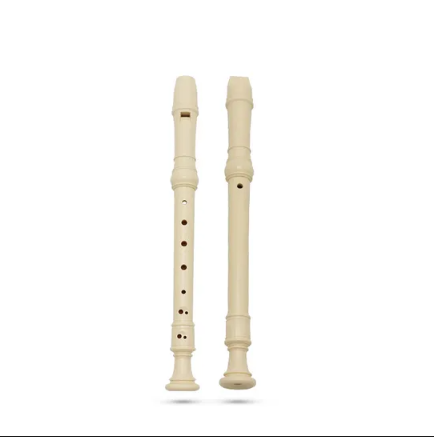
Stock Baroque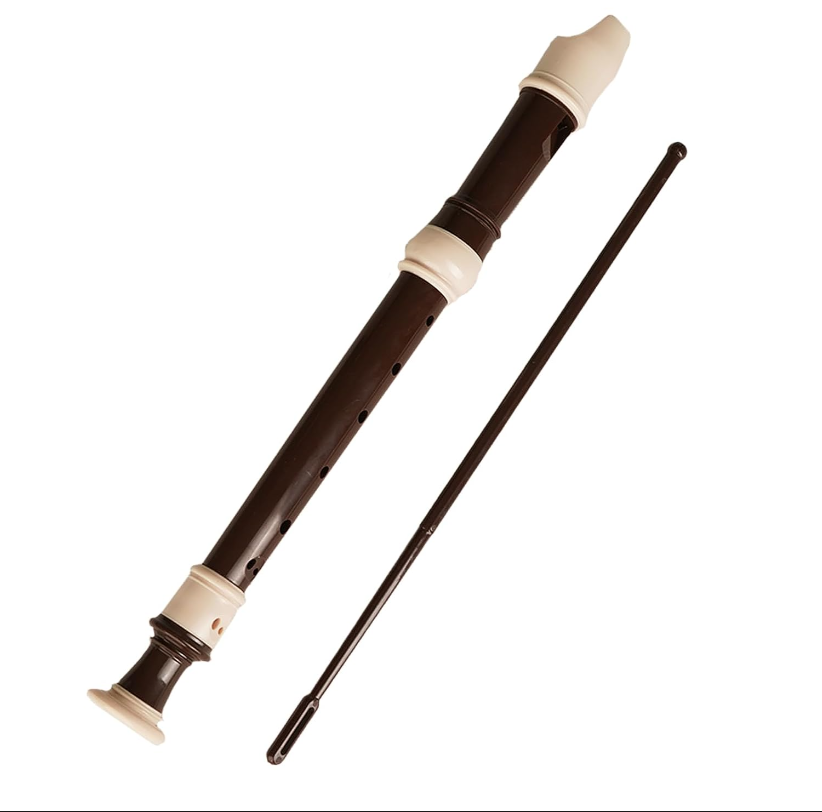
Part 1: Expanded FAQ
For Individual Buyers & Parents :
Q1: My child needs a recorder for school. Should I get German or Baroque?
A: Always check with the music teacher first, but when in doubt, choose Baroque (English). About 95% of standard school music programs strictly require the Baroque fingering system. German recorders are typically only used for casual, early childhood programs.
Q2: How can I tell which style I currently have?
A: Look at the bottom half of your recorder (holes 4 and 5, counting down from the mouthpiece). If Hole 4 is smaller than Hole 5, it’s a German style. If Hole 4 is visibly larger than Hole 5, you have a Baroque recorder.
Q3: Why does my recorder sound completely out of tune or squeaky?
A: If the “F” note sounds wrong, you are likely using Baroque fingering on a German recorder (or vice versa). Check the fingering chart included in your bag. If the recorder is squeaking, it usually means you are blowing too hard, or condensation (moisture) has built up in the mouthpiece. Briefly cover the windway and blow sharply to clear the moisture.
Q4: What are the two small double-holes at the very bottom for?
A: Those are designed to help you play half-steps (chromatic notes) like C/C# and D/D# clearly. Instead of awkwardly half-covering a single large hole, you simply lift one finger to uncover one of the two smaller holes.
Q5: Is this instrument suitable for left-handed players?
A: Yes! Our 3-piece recorder design allows you to rotate the bottom section (the foot joint). Left-handed players can simply twist the bottom joint so the final hole aligns comfortably with their left pinky finger.
For Schools, Teachers & Wholesale :
Q6: We are buying for a whole classroom. Why choose ABS Resin over wood?
A: ABS Resin is the ultimate workhorse for classrooms. It is highly durable, survives drops on hard floors, and is unaffected by humidity. Most importantly, ABS recorders can be fully disassembled and washed with warm soapy water, ensuring strict hygiene when shared among students year after year.
Q7: Do these come with everything a student needs to start?
A: Yes. Every single recorder comes pre-packaged as a complete set. The box includes the 3-piece recorder, a custom-fitted carrying bag (to protect it in backpacks), a cleaning rod, and a detailed fingering chart.
Post time: Jul-20-2026