




1. Strings and Construction
The string material drives every other difference.
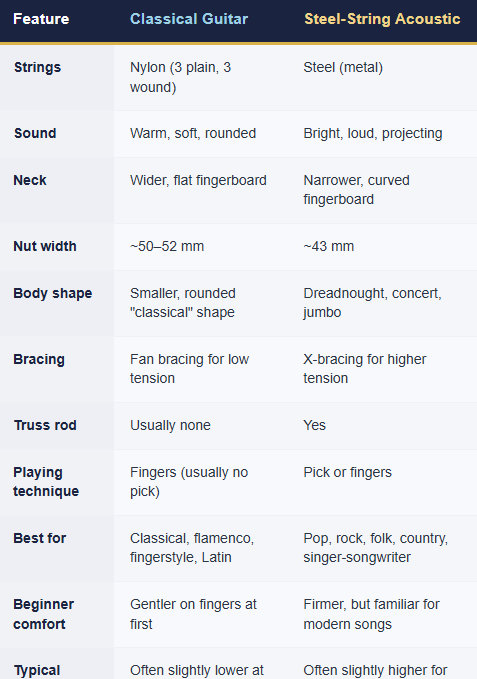
Nylon strings have much lower tension than steel strings. A classical guitar is built light and responsive to suit that lower tension: fan-pattern bracing under the soundboard, a tied bridge, and usually no truss rod because the neck does not need to resist heavy pull.
Steel strings exert far more tension. A steel-string acoustic therefore uses stronger X-bracing, a reinforced neck with an adjustable truss rod, and a pinned bridge. This is why the two instruments sound and feel so different — and why the bodies, though similar in outline, are not interchangeable.
Important: Never put steel strings on a classical guitar. The extra tension can warp or crack the neck and soundboard. Putting nylon on a steel-string guitar will not damage it, but the tone will be dull and quiet.
2. Sound and Volume
Classical guitars produce a warm, intimate, rounded tone with strong fundamental notes and fewer metallic overtones. They are not as loud as steel-string guitars, but the sound is sweet and even — ideal for solo fingerstyle pieces, arpeggios and classical repertoire.
Steel-string acoustics are brighter, louder and more cutting, with strong projection and sustain. That is why they dominate strummed accompaniment, singing, bluegrass flatpicking and stage performance where the guitar needs to be heard over other instruments.
Neither is “better” — it depends on whether you want warmth and expression or volume and presence.
3. Playability and Comfort
This is where beginners feel the difference most.
Nylon strings are softer and easier on uncalloused fingertips. In the first weeks of practice, a classical guitar is usually more comfortable. The wider, flat neck also gives each finger more room — helpful for fingerstyle and complex chord shapes, though players with small hands may find the stretch tiring at first.
Steel strings are firmer and require more finger pressure; beginners typically develop calluses faster and feel more discomfort early on. The narrower, curved neck is more familiar to most players and makes barre chords and single-note leading easier for many people.
A useful rule: if comfort in week one is your priority, classical wins. If you want to play the songs you hear on the radio, steel-string is the better long-term fit.
4. Music Styles: What Each Guitar Was Built For
Choose a classical guitar if you are drawn to:
- Classical and Spanish repertoire
- Flamenco and bossa nova
- Latin and world music
- Fingerstyle and instrumental arrangements
Choose a steel-string acoustic if you are drawn to:
- Pop, rock, indie and singer-songwriter music
- Folk, country, bluegrass and Americana
- Strumming chords while singing
- Worship and campfire/accompaniment playing
Many guitarists eventually own both — the instruments simply excel at different things.
5. Which Is Better for Beginners?
It depends on the goal, not on the instrument.
- Young children or players with sensitive fingers: A classical guitar is often the gentler start; nylon strings reduce early fingertip pain.
- Someone who wants to play modern pop, folk or rock songs: A steel-string acoustic matches the sound and technique used in those songs, so skills transfer directly.
- Unsure? Consider trying both in a store. The right guitar is the one that makes you want to pick it up and practise.
The good news: chord shapes and music theory are the same on both. Switching later is easy — it only takes a short adjustment to the different neck width and string feel.
6. Price and Maintenance
At the entry level, a well-made classical guitar can sound surprisingly good for the money, because its lighter construction is simpler to build. Steel-string acoustics often need a slightly higher budget to achieve a comparable level of tone and playability.
In terms of care, both respond to the same basics: keep them in a case, away from extreme humidity and heat, and wipe strings after playing. Nylon strings last longer and are cheaper, while steel strings are replaced more often but are widely available everywhere.
7. Buying for a Store or Online Shop? Stock Both.
If you are a retailer, distributor or brand owner, this is not an either/or decision. The two categories serve different customers, and stocking both widens your reach:
- Beginner and educational market: Classical guitars are popular with music schools and parents buying for children, thanks to softer strings and lower entry prices.
- Modern music market: Steel-string acoustics drive demand among singer-songwriters, folk and pop players, and are a natural step toward electric guitars.
- Bundle opportunity: Starter kits — guitar, bag, tuner, strap, picks, spare strings — convert well in both categories and lift average order value.
A supplier that offers both categories from one factory simplifies sourcing, packaging and shipping. For example, Huasheng’s guitar range covers classical guitars, steel-string acoustic guitars, electric guitars and more, with OEM/ODM options for branding and bundles.
How to Decide in 30 Seconds
- Want warm, fingerstyle, classical or flamenco sounds, or the softest start for a child? → Classical
- Want to strum modern songs, sing along, or play pop, folk, country or rock? → Steel-string acoustic
- Buying for a young beginner and unsure of the musical goal? → Classical first, then move to steel-string when the player is ready.
- Still torn? → Play both. Your hands will usually decide faster than your head.
Frequently Asked Questions
Is a classical guitar easier for beginners?
Often yes at the very start, because nylon strings are gentler on the fingertips and require less pressure. Beyond the first few weeks, “easier” depends more on the style of music you want to play.
Can I play pop or rock songs on a classical guitar?
You can play the same notes and chords, but the tone will be warmer and quieter, and the wider neck makes strumming and barre chords less comfortable. For an authentic pop/rock sound, a steel-string acoustic is the better tool.
Are classical guitars cheaper than acoustic guitars?
At beginner price points, classical guitars are often slightly cheaper because they use lower string tension and simpler bracing. Compare quality within each category rather than across them.
Can I switch from classical to steel-string later?
Yes. The theory and chord shapes transfer directly. Expect a short adjustment period for the narrower neck and firmer strings.
Do electric guitars count as acoustic guitars?
No. Electric guitars rely on pickups and amplification. This guide compares the two main unamplified, hollow-body guitar families.
Find the Right Guitar for Your Next Customer or Your First Song
There is no universal winner in the acoustic vs classical guitar debate — only the instrument that fits the music, the hands and the budget. Understand the differences, try both if you can, and choose with confidence.
If you are sourcing guitars for resale or your own brand, explore Changshu Huasheng Musical Instrument Co., Ltd., a manufacturer with over 20 years of experience producing classical, acoustic, electric and ukulele instruments, with flexible OEM/ODM options and export support worldwide.
Browse the full guitar range or request a sample pack today.
Post time: Nov-24-2026